
Why Primora
Everything that happens in soil happens through water.
Almost every explanation for what is going wrong in agriculture reaches for something to add: nutrients, microbes, carbon, cover. Primora Bio was built on the variable most people overlook. Not how much water, but what kind.
Sound familiar?
Different growers. The same complaints.
Raised bed, greenhouse bench or forty acres, we hear the same things again and again.
“I’m doing everything right.”
You water on schedule and feed on schedule, and things still look stressed or grow slowly. Something invisible is wrong.
“The soil test says it’s all there.”
The minerals are in the ground. They lock up in the soil, the reservoir and the lines before a root ever gets to them.
“My water changes every season.”
Scale, bicarbonate, sodium, and a source that never stays the same. You spend your time adjusting around it.
“The inoculants never take.”
Microbial products and amendments fail to establish in tired ground. Biology needs the right medium before it needs another input.
“The residue won’t go away.”
What was applied stays in the soil and the plant tissue long after you stopped applying it.
“Recovery is taking years.”
Rebuilding soil is the right path, but it’s slow. Most growers can’t wait out a three-to-five-year gap.
What if the problem isn’t your soil, your fertilizer or your technique, but your water?
The shift
In a single century, the water changed.
The water we grow with today is chemically unrecognizable from the water agriculture ran on for ten thousand years.
It has been altered three times over. Overpumping drew wells down into deeper, older, more mineralized ground, and pulled seawater inland along the coasts. From above, a century of fertilizer and irrigation laid down its own residue of salts and nitrate. Then modern treatment stripped out much of what survived.
In a garden or on a farm, the change comes slowly enough to be accepted as normal. Salts build up until a crop runs dry in visibly wet ground. Sodium crowds calcium and magnesium off the clay and water stops soaking in. Carbonate chemistry climbs, and the minerals lock up. They are still in the ground. The water can no longer move them.

20×
rise in synthetic nitrogen use in the second half of the twentieth century
Glyphosate rose roughly fifteenfold between 1995 and 2014. All of it moves through the same soil water.
262M acres
of cropland degraded by salinization
An area the size of Texas and California together. Under intensively farmed land, over half of shallow groundwater samples now exceed the nitrate limit for drinking water.
4 staples
with yield growth stalling — maize, wheat, rice and soybean
Maize, wheat and rice peaked region by region across the 1990s, and 24–39% of harvested area for the four great staples is now stagnant or falling. Rice — the thirstiest crop we grow — is slowing fastest, now 0.63% a year.
−50%
iron in fruit and vegetables, part of a broad decline in mineral content since 1940
In UK produce every mineral measured has fallen but one: copper 49%, sodium 52%, magnesium 10%. Adjusted for moisture, so it is not simply that produce holds more water.
In the national numbers it looks like nothing at all. Yields still rise, just by less each decade, and a slope that is only flattening alarms no one.
The coordination layer
Change the water, and you change all of it at once.
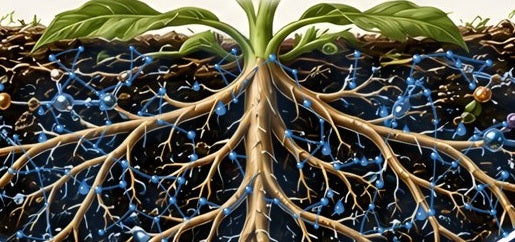
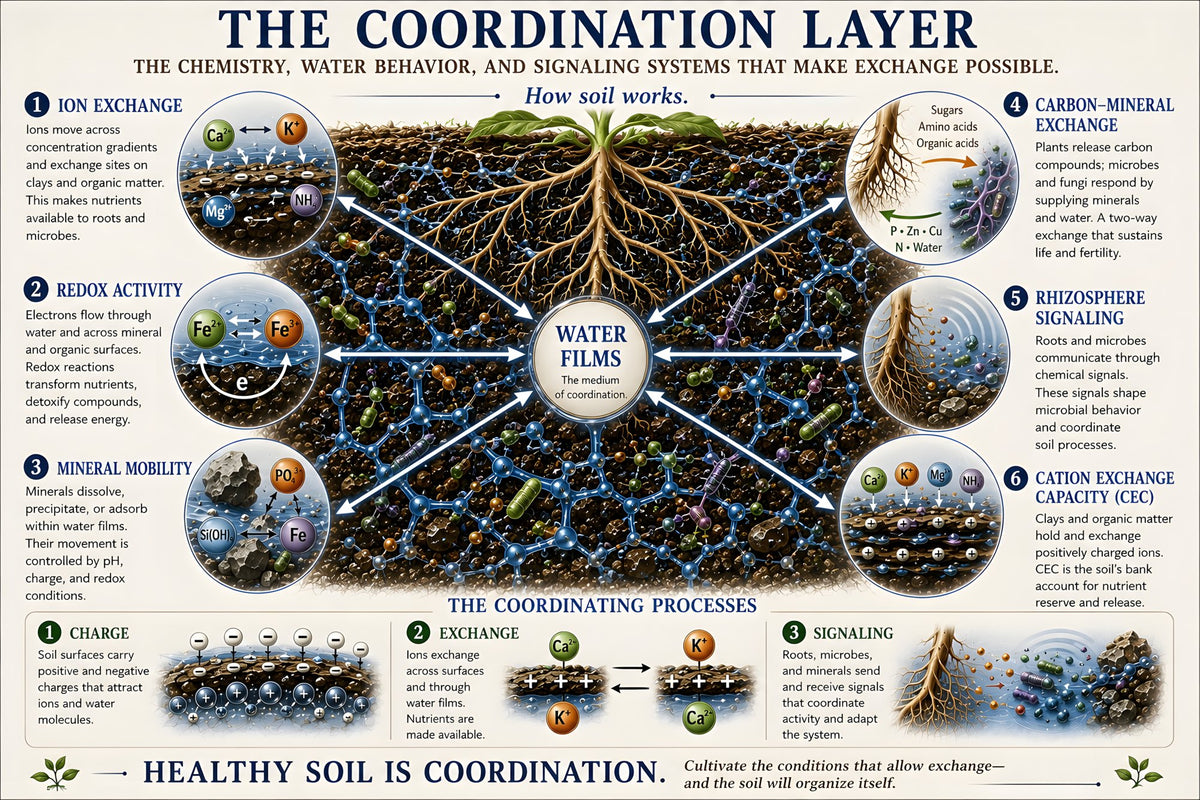
Ion mobility, redox exchange, diffusion, the chemical signals microbes use to talk to roots. All of it happens in films of water only molecules thick, wrapped around every particle in the ground.
The whole exchange between rock, microbe and root comes down to six processes, and every one of them runs in that film. Change the water and you change the conditions all six work under.

Why this hasn’t been solved
Every fix for bad water works by taking something out.
Acid to knock down bicarbonate. Gypsum to displace sodium. Filtration for solids, reverse osmosis to strip salt, blending to dilute it. Each one removes one variable at a time, and none of them puts anything back.
Primora Bio works several ways at once. It binds over 245 tested contaminants so they stop moving freely. It gives back the mineral character that softening, filtration and desalination stripped out. And it restores the water’s capacity to carry and exchange minerals, along with its redox balance: the working properties that decide whether anything dissolved in it can move at all.
You get all of it in a single pass, at any scale you grow.
The difference
An input acts on the parts. Primora Bio acts on what the parts share.
Every input in agriculture works on one or two pieces of the system, and you can say in advance which ones.
Fertilizer
feeds the plant
Fungicide
kills a pathogen
Biochar & inoculants
house or add microbes
Water treatment
removes one variable
Primora Bio
conditions the water all of them work in
That is why the record shows reported effects across thirteen biological systems at once, from the germinating seed to the fish in a pond. It is also why Primora Bio sits underneath your program instead of replacing any part of it. Here they are ↓
The record
Thirteen biological systems. One direction.
The strongest reported finding from each system that was independently measured. Different crops, countries, decades and investigators, and the change points the same way every time.
Realm IPlant development
-
Germination & establishment
+18%germination after seed pre-soak
-
Vegetative growth
+15% / +17%plant height / tiller number
-
Photosynthesis & chlorophyll
up to +40%electron transport rate
Realm IICrop yield & quality
-
Reproductive development & yield components
+37%filled grains per panicle
-
Yield, growth & productivity
15–38%higher crop yield · +25% at Wakayama
-
Mineral nutrition, uptake & retention
Iron +148%in citrus leaf tissue
-
Metabolic quality & composition
Terpenes +50–75%plus 3–4 terpenes absent from controls
Realm IIIContaminant & stress response
-
Contaminant handling in plant tissue
~50% lesspesticide accumulation in tissue · 75–85% in the strongest cases
-
Antioxidant & redox chemistry
Into human cellshigher SOD, lower reactive oxygen species
-
Disease & mold pressure
~85% fewerplants showing mold
Realm IVWater & ecosystem
-
Water purification & chemistry
70% to >99%recorded reductions
-
Aquaculture production
~50% fasterto market size · +30% stocking density · +44% market price
-
Ecosystem & biodiversity
1.6×aquatic insect diversity
No adverse effects observed in the systems that were tested, across field studies, trials, laboratory tests and aquaculture operations.
Most of this record is observational, and a result obtained with one crop or setting may not carry to another. See every source, study grade and limit →
Easy to use
Just add it to the water you already use.
No new equipment
It goes in the watering can, the sprayer, the drip line or the reservoir. No new equipment and no change to your system.
Keep your routine
It works alongside compost, fertilizer, biologicals and cover crops. Keep your program. Change the water it runs through.
Pennies a gallon
Half an ounce treats five gallons of irrigation water: as little as — a gallon from the 2.5-gallon jug. Foliar spray runs —–— a gallon.
Wherever you grow
Whatever you grow, start with the water.

Home & garden
A small measure in every watering can, plus a foliar spray every week or two.

Regenerative growers
You’ve been building the parts: carbon, cover, biology. This is the layer that connects them.

Greenhouse & indoor
The one variable you control completely. Works with hydroponics, aquaponics and fertigation.
 Not yet available
Commercial farms
We can’t yet supply at field scale. Tell us what you farm and we’ll come to you first.
One more reason
We print the limits next to the findings.
Much of the record behind Primora Bio is historical, observational or single-operator, and we say so beside every figure we publish. We’d rather you weigh the evidence yourself than take a number from a sales page.
Supercharge your water. Watch everything grow.
A trace dose, in the watering you already do.