
Our story
It began with the habit of looking underneath.
Dr. Pierre Kory spent his career in intensive care, much of it as an ICU director. The discipline teaches one habit above all others: when a patient is failing in a dozen ways at once, resist the urge to chase each falling number and hunt instead for the single insult beneath the whole collapse. Reverse that, and the systems that looked like a dozen separate failures begin to re-coordinate on their own.
Years later, studying chronic illnesses that resist simple explanations, he kept following that instinct downward — past the symptom, past the organ, toward whatever sat underneath. In 2024 it led somewhere he did not expect: to the work of a Japanese pharmacist who had asked a similar question about a tree.
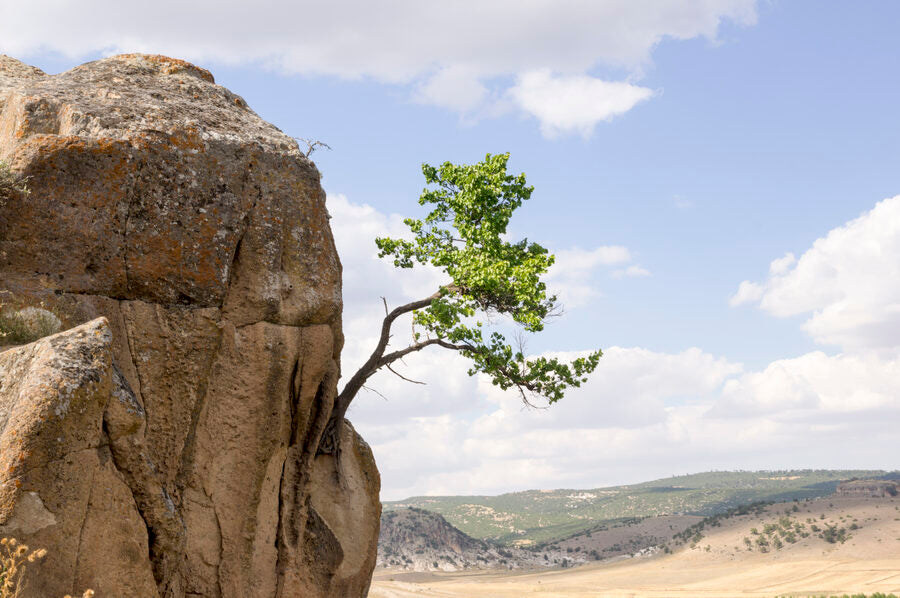
A tree growing out of bare rock. No soil, no one tending it. So where was it getting what it needed?
In the 1950s, sitting by the water in post-war Japan, Asao Shimanishi noticed a tree rising directly out of what looked like naked stone — just a crack in a granite boulder, and a trunk emerging from it. He reasoned that rainwater pooling in that crack had dissolved a little of the rock, and that the tree was living on what the water had taken from the stone.
He could not let the question go. Trained as a pharmacist, he turned away from synthetic chemistry and toward the materials that had drawn him since childhood — rocks, and the hidden processes by which the living world sustains itself. It took fifteen years. In 1977 he arrived at a method for liberating a broad spectrum of minerals out of weathered volcanic biotite and into an aqueous solution, something that had been considered impossible.
What he found next was the part that mattered. Added to water, that solution changed how the water behaved — and what changed downstream of it was not one thing but many, across systems that had nothing in common except the water running through them.
That record, largely untranslated and almost unknown outside Japan, is what Dr. Kory spent the following year reading. It produced three books, and it produced two companies — because the same chemistry turns out to serve two different mediums.


