
How Primora Bio works
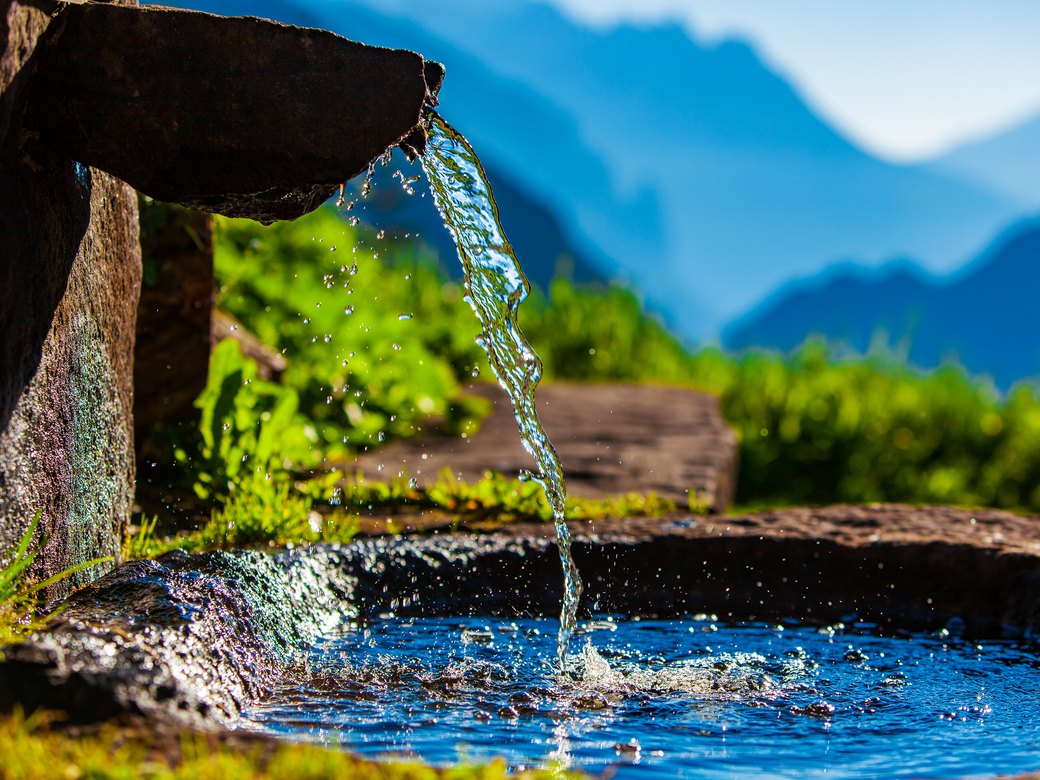
Water is conditioned by the rock it passes through.
Agriculture treats water as a mechanism for delivering inputs. Its own chemistry matters more: it is the medium that determines how well soil biology functions, whether minerals stay available, and whether a plant has what it needs to grow and to defend itself. Here is what is established, and what is proposed.
01
The shift
What irrigation water used to carry, and what it carries now.
02
The chemistry
Why some dissolved ions organize water for biology, and others do not.
03
The mechanisms
How a broad spread of elements, all at trace amounts, changes the way water behaves.
04
The measurement
What testing revealed about light passing through three different waters.
The shift · Geodynamic water
Same field. Same source. Different water.
The change is in the water itself — what it picked up along the way, and what has been taken back out of it. The soil responds to the difference.
What used to arrive
Water shaped by rock
For most of human history, agricultural water moved slowly through mineral-bearing ground — dissolving elements, exchanging ions, taking part in redox reactions, and arriving at soil carrying the chemical signature of that passage.
- Slow contact — months or years through rock
- Rich in order-building ions: sulfate, magnesium, iron
- Stable electrochemical gradients
- The mineral architecture soil biology evolved alongside
- Nothing dissolved in it that the last two centuries invented
What arrives now
Water shaped by everything since
Wherever it comes from — a well, a canal, a ditch, a municipal line — water now moves through a world that has been chemically rearranged. Industry and eight billion people have loaded it with compounds that did not exist a century ago, and farming has laid down its own century of salts and nitrate on top. Then, when water is treated, softening and filtration take out most of the mineral character that remained.
- Synthetic compounds in the hundreds of thousands, none of them here in 1900
- A century of fertilizer salts, nitrate and residue loaded from above
- Overdrawn wells reaching deeper, saltier ground, and seawater pulled inland
- Where treatment is used, mineral character stripped along with the rest
- Loss of the buffering that once absorbed all of it
Every grower has noticed that plants respond to rain in a way they do not to irrigation. Some of that is the protective weather that comes with it. The rest is that rain carries none of the accumulated salt, sodium, bicarbonate or chemical residue. But rain is also empty — it has been charged by no rock at all. Lifting the burden is one thing. Putting something back is another. Nothing a grower has ever been able to buy does both.
The chemistry of the world’s water has been altered over the last hundred years. Across agriculture that shows up in four places, each one setting in slowly enough to be accepted as the new normal.
Coordination breaks down
The mineral-water environment that mycorrhizal networks and nutrient-cycling microbes depend on degrades.
Nutrients lock up
Minerals precipitate out of solution before they ever reach a root.
The input list keeps growing
What the soil once did for itself has to be bought and applied — more of it each season, and more different products, to hold the same yield.
Plants take stress harder
A dry week, a disease pressure, a hot spell — each one costs the crop more than it used to, and costs more to answer.
A soil test tells you what the ground holds. It cannot tell you what the water will move.
The established chemistry
How water behaves depends on what is dissolved in it.
Chemists have been sorting ions by that effect since 1888, in an ordering known as the Hofmeister series. Some ions pull the water around them into a tight, orderly arrangement. Others leave it loose and scattered.
Order-building
Organized water supports biology.
These ions strengthen water’s hydrogen-bond network, stabilize the hydration shells around proteins and enzymes, support membrane integrity, and create conditions where biological gradients persist. Minerals stay in solution.
Order-disrupting
Disorganized water burdens it.
When water is stripped of mineral character, or carries ions that disrupt hydrogen bonding, that stability erodes. Membrane function degrades, microbial communities fragment, nutrients precipitate. The system works harder and delivers less.
What Primora Bio contains
An unusually dense spectrum of order-building ions.
The dissolved profile, drawn from volcanic biotite, is concentrated in exactly the class of ions that pull water into order — and that is what makes the chemistry work.
- Sulfate (SO₄²⁻) — by an enormous margin the dominant constituent, and one of the most strongly order-building ions in water chemistry.
- Iron (Fe²⁺/Fe³⁺) — drives electron transfer. Central to the redox cycles behind soil nutrient cycling, and the metal that gives the solution its optical signature.
- Magnesium (Mg²⁺) — essential to ATP reactions, enzyme activation, chlorophyll and membrane stability in both plants and microbes.
- Twenty-nine elements, individually measured across two certificates of analysis. Geological studies have documented more than forty across biotite and its close relatives, and one expert assessment puts the rock’s capacity as high as eighty. Twenty-nine is what has been measured, and twenty-nine is what we claim.
- Purified water, with 1% ionic mineral salts. Everything listed above sits inside that one percent — and in the field it is diluted again, roughly two hundred and fifty fold, which puts the minerals themselves at about forty parts per million. See the full elemental analysis
The mechanisms
Three mechanisms, one medium.
These are the mechanisms thought to explain the outcomes presented on the evidence page. They are interpretations of the findings — based on scientific reasoning and consistent across biological systems — and more controlled testing is needed to validate them.
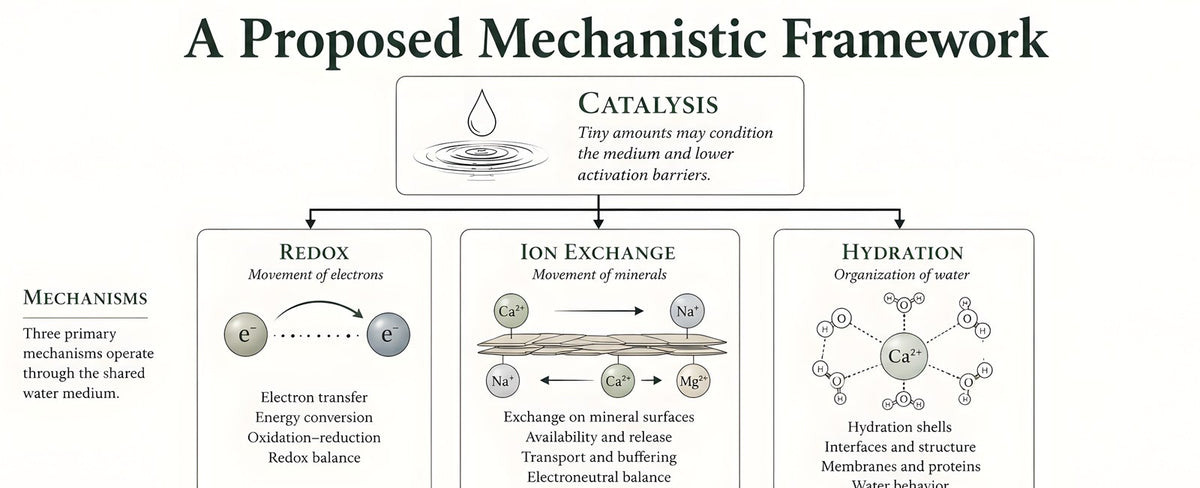
One
The medium organizes
A sulfate-dominant solution changes how water molecules move and organize around dissolved ions. Nearly every reaction in biology happens at a surface, inside those thin hydration layers — so this is the condition the other two work inside.
Two
Electrons move
Redox-active minerals shift the water’s electron balance, and that balance decides what form a mineral takes. Iron and manganese reach a root in their reduced forms and lock away in their oxidized ones — which is how an element can read abundant on a soil test and still be absent from the crop.
Three
The right minerals move
Exchange turns selective, because binding affinity is not equal across elements. Nutrient cations sit loosely on a mineral surface and trade off into solution where a root can reach them; heavy metals and many contaminants hold far more tightly and stay put. The change is in how the entire existing inventory behaves, not in what was added to it.
Boundaries
What we do not claim.
Mechanisms explain how something works. Evidence shows whether it does.
Seventy-five reported outcomes across thirteen biological systems — each with its source, its study grade and its limits.